
Choosing the right decoration method for custom clothing can have a major impact on how your products look, feel, perform, and sell. In 2026, businesses have more options than ever, including DTF printing, screen printing, and embroidery. Each method has clear strengths, but none is automatically the best choice for every garment, design, order size, or budget.
If you are creating branded T-shirts, employee uniforms, promotional clothing, teamwear, hats, jackets, workwear, or merchandise, the right decision depends on what you are trying to achieve.
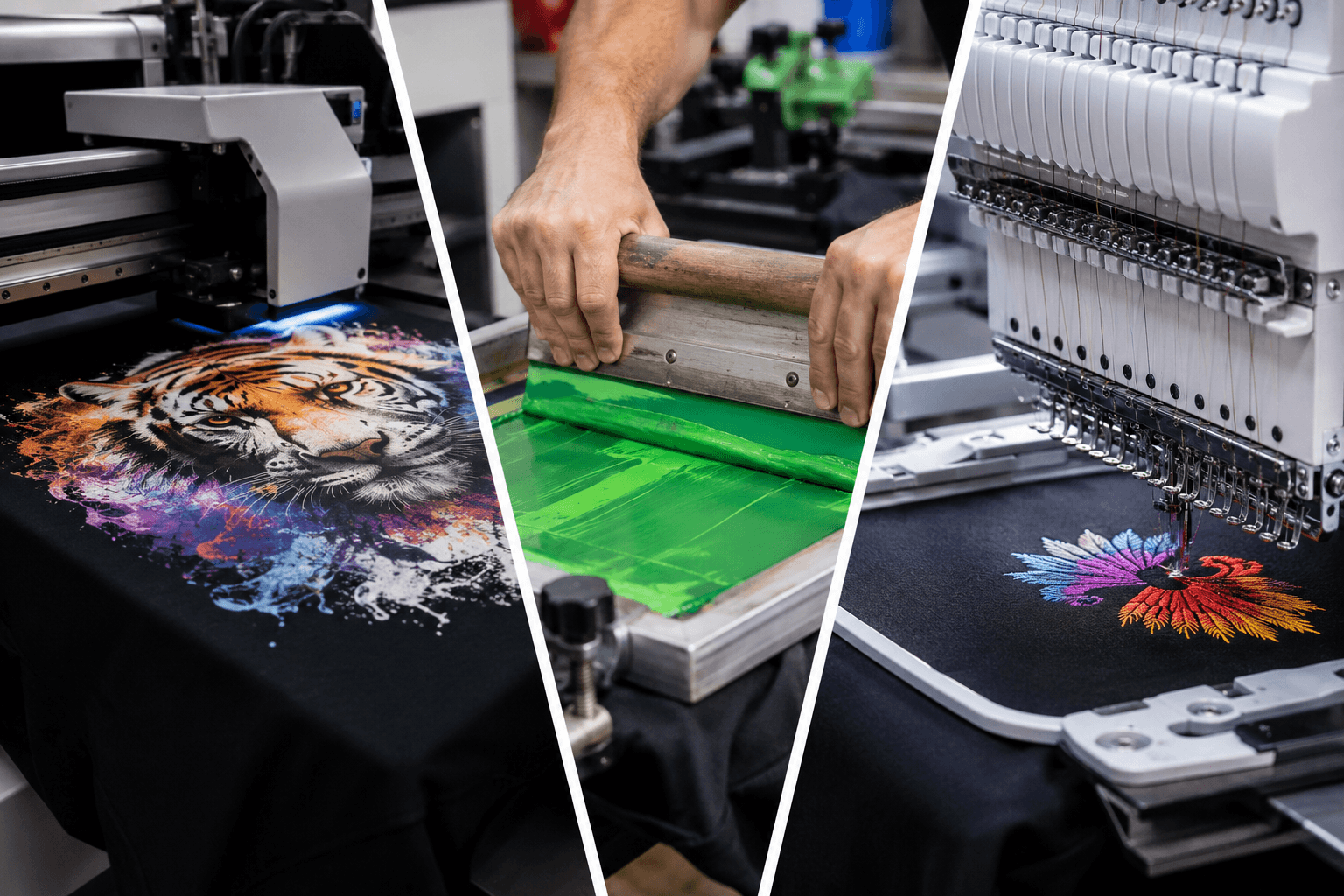
DTF printing is known for flexibility and detailed full-colour designs. Screen printing remains a popular option for bold graphics and larger production runs. Embroidery creates a textured, professional finish that works particularly well for logos, uniforms, hats, polos, and premium apparel.
So, which one should your business choose?
The honest answer is: it depends on your design, garment, quantity, budget, and desired appearance.
This guide compares DTF printing vs screen printing vs embroidery across the factors that matter most to businesses in 2026.
Quick Comparison: DTF vs Screen Printing vs Embroidery
| Factor | DTF Printing | Screen Printing | Embroidery |
|---|---|---|---|
| Best for | Detailed, colourful designs | Bold graphics and bulk orders | Professional logos and premium branding |
| Colour capability | Excellent | Excellent, but colour count can affect setup | Thread colours |
| Fine details | Excellent | Good to excellent | Limited by stitch size |
| Gradients & photographs | Excellent | More challenging | Not ideal |
| Small orders | Very suitable | Less economical depending on setup | Suitable |
| Large orders | Suitable | Excellent | Excellent |
| Texture | Smooth printed finish | Ink-based printed finish | Raised, textured finish |
| Best garments | T-shirts, hoodies, many fabrics | T-shirts, sweatshirts, apparel | Polos, jackets, hats, uniforms |
| Premium appearance | Good | Good | Excellent |
| Design flexibility | Very high | High | Moderate |
| Main limitation | Print feel and application requirements | Setup and colour considerations | Fine detail and stitch density |
What Is DTF Printing?
DTF printing, or Direct-to-Film printing, is a garment decoration method that transfers a digitally printed design onto fabric using a special film and adhesive powder.
Unlike traditional screen printing, DTF does not require a separate screen for every colour. This makes it particularly useful when a design contains multiple colours, gradients, intricate artwork, small details, or photographic elements.
A DTF workflow generally involves preparing the artwork digitally, printing it onto transfer film, applying adhesive powder, curing the transfer, and then applying it to the garment with heat.
One of the biggest advantages of DTF is design flexibility.
A business could use a detailed illustration, colourful logo, photographic image, gradient, or complex graphic without needing to simplify the artwork into a limited number of solid-colour screen layers.
If you are comparing digital garment decoration methods, you may also want to see the existing guide on screen printing vs DTG printing for another useful comparison.
Advantages of DTF Printing
DTF can be an excellent option when you need:
- Full-colour artwork
- Detailed designs
- Gradients and complex graphics
- Small or medium-sized orders
- Multiple designs in the same production run
- Custom names or individual designs
- Flexible garment decoration
- Fast design changes without traditional screen setup
DTF is particularly attractive for businesses producing custom merchandise where every design does not necessarily need to be identical.
Limitations of DTF Printing
DTF is not perfect.
The printed transfer can have a different feel from ink that is absorbed or cured directly into the fabric. Large areas of printed artwork may also feel more noticeable on the garment.
The final result can depend heavily on artwork preparation, transfer quality, garment compatibility, heat-press settings, curing, and application technique.
For businesses wanting a traditional, bold printed appearance across a large number of identical garments, screen printing may still be the better choice.
What Is Screen Printing?
Screen printing is one of the most established methods of decorating garments. The process uses screens to transfer ink onto the fabric, with individual screens typically used to create different colour layers in the design.
Screen printing is especially popular for T-shirts, hoodies, promotional apparel, uniforms, event merchandise, and branded clothing.
For businesses ordering larger quantities of the same design, screen printing can offer excellent production efficiency.
The technique is particularly effective for bold logos, typography, illustrations, and graphics that use strong areas of colour.
You can learn more about the fundamentals in the existing guide to what screen printing is on T-shirts.
Advantages of Screen Printing
Screen printing can be a strong choice for:
- Bulk apparel orders
- Bold logos
- Simple or moderately complex artwork
- Promotional T-shirts
- Event merchandise
- Company uniforms
- Strong solid colours
- Designs that need a traditional printed appearance
When the same design is being produced repeatedly, the initial setup can be spread across a larger number of garments, potentially making the process more economical per item.
Limitations of Screen Printing
The main consideration is setup.
Screen printing generally requires preparation for the artwork and colour layers before production begins. Designs with many colours can require additional setup and production considerations.
That does not make screen printing unsuitable for detailed artwork, but it can make DTF more convenient when you need highly complex, full-colour graphics or frequent design changes.
If cost is one of your main concerns, compare your project against the information in the screen printing prices guide and the guide covering screen printing cost per shirt.
What Is Embroidery?
Embroidery uses thread stitched directly into fabric to create a design, logo, name, or decorative pattern.
Instead of placing ink or a printed transfer onto the garment, embroidery creates a physical, raised design made from thread.
This gives embroidered apparel a distinctive texture and a professional appearance.
Embroidery is especially common for:
- Business polos
- Work uniforms
- Corporate clothing
- Caps and hats
- Jackets
- Sweatshirts
- Hospitality uniforms
- Sportswear
- Premium branded apparel
If you are new to the process, the complete guide to embroidery digitizing explains why artwork must be converted into a suitable embroidery format before it can be stitched by a machine.
Advantages of Embroidery
Embroidery is particularly strong when your goal is a professional and durable-looking brand identity.
It works exceptionally well for logos containing:
- Simple shapes
- Bold lettering
- Limited colours
- Clear outlines
- Medium-sized design elements
An embroidered logo on a polo shirt or jacket can immediately create a more corporate and premium appearance than a standard printed graphic.
Embroidery is also highly effective on caps, where traditional printing techniques may not provide the same visual effect.
Limitations of Embroidery
Embroidery is not ideal for every type of artwork.
Highly detailed photographs, very small text, subtle gradients, and extremely fine artwork can be difficult to reproduce accurately with stitches.
Embroidery also adds physical texture and weight to the garment. Large designs can therefore become uncomfortable or overly heavy, particularly when compared with a printed design.
The artwork must also be digitized correctly. Poor digitizing can result in problems such as excessive stitch density, puckering, gaps, poor registration, or an unclear design.
For logo work, see the guide on how to digitize a logo for embroidery.
DTF Printing vs Screen Printing vs Embroidery: Which Looks Best?
There is no universal winner because the visual result depends on the design and the garment.
DTF Appearance
DTF is generally the strongest choice when you want:
- Photorealistic artwork
- Gradients
- Many colours
- Small design details
- Illustrations
- Complex graphics
It gives businesses significant creative freedom.
Screen Printing Appearance
Screen printing works especially well for:
- Bold graphics
- Large logos
- Typography
- Solid colours
- Promotional designs
It can produce a strong, classic printed appearance that remains popular for branded merchandise.
Embroidery Appearance
Embroidery stands out because of its texture.
The stitched finish can make a simple logo feel more substantial and premium. This is one reason embroidered logos are so common on company uniforms, polos, jackets, and hats.
For more ideas, see these resources on custom embroidery and high-quality embroidery designs.
DTF vs Screen Printing vs Embroidery for Small Orders
Small orders change the economics of garment decoration.
If you need only a few garments, traditional production setup can represent a larger proportion of the total cost.
DTF can be attractive for small orders because digital artwork can be prepared without creating traditional screens for each design.
Embroidery can also work well for small quantities, particularly when the design is a straightforward business logo.
Screen printing may still make sense for small orders, but you should compare the setup requirements and total project cost rather than assuming one method is automatically cheaper.
For businesses specifically considering small screen-printing runs, the guide on the average screen printing cost for small orders provides additional context.
Which Method Is Best for Bulk Orders?
For large quantities of identical garments, screen printing has traditionally been a strong option.
Once artwork and production setup are prepared, repeating the same design across many garments can be efficient.
Embroidery can also be highly effective for bulk uniforms, particularly when the same company logo is being applied to dozens or hundreds of polos, jackets, caps, or other workwear items.
DTF can handle bulk orders too, especially when the artwork is highly detailed or when the order contains several different designs.
The key question is not simply “Which method is cheapest?”
Instead, ask:
- How many garments do I need?
- Is every garment using the same design?
- How many colours does the design contain?
- Is the artwork photographic or highly detailed?
- What type of garment am I decorating?
- Do I want a printed or stitched finish?
- Is premium appearance more important than minimum cost?
Which Is Best for Company Uniforms?
For many businesses, embroidery is the natural choice for uniforms.
A stitched company logo on a polo, shirt, jacket, or cap can create a professional and consistent appearance across an entire team.
Embroidery is especially suitable for:
- Offices
- Hotels
- Restaurants
- Tradespeople
- Retail businesses
- Construction companies
- Security companies
- Delivery teams
- Sports organisations
However, DTF or screen printing can be better when the uniform requires a large back graphic, colourful artwork, promotional message, or detailed design.
In some cases, combining methods is the smartest option.
For example, a company could use an embroidered logo on the chest and screen-printed or DTF artwork on the back.
Which Is Best for T-Shirts?
T-shirts are one of the most flexible garment categories because all three methods can work.
Choose DTF for:
- Detailed artwork
- Full-colour graphics
- Small quantities
- Personalised designs
- Photographic artwork
Choose screen printing for:
- Bulk T-shirts
- Bold branding
- Simple graphics
- Event merchandise
- Promotional campaigns
Choose embroidery for:
- Small chest logos
- Premium apparel
- Fashion-focused designs
- Brand marks that benefit from texture
For more design inspiration, explore these custom T-shirt design ideas.
Which Is Best for Hats and Caps?
Embroidery is usually the strongest choice for hats and caps because stitching naturally complements the structure of the garment.
A well-digitized logo can produce a clean and professional result on the front of a cap.
For more information, see the guide on how to digitize a logo for a baseball cap.
For larger or dimensional branding, businesses can also consider specialized embroidery techniques such as 3D puff embroidery. You can learn more from the guide to 3D puff embroidery.
Which Is Best for Detailed Designs?
For extremely detailed, multicolour, or photographic designs, DTF generally provides the most flexibility.
Screen printing can reproduce detailed artwork, but the production process may become more involved as the number of colours and design complexity increases.
Embroidery has the greatest limitations when artwork contains tiny details, gradients, or photographic elements because the image must ultimately be represented through stitches.
This is why artwork preparation is so important for embroidery.
A design that looks perfect on a computer screen is not necessarily ready to be embroidered.
DTF vs Screen Printing vs Embroidery: Durability
Durability depends on more than the decoration method itself.
The final lifespan can be influenced by:
- Garment quality
- Decoration quality
- Ink, transfer, or thread quality
- Application settings
- Stitch density
- Washing temperature
- Detergent
- Drying method
- Frequency of use
Screen printing is well known for producing durable garment graphics when properly produced and cared for.
DTF can also provide durable results when quality transfers are correctly applied to suitable garments.
Embroidery creates a stitched design rather than a printed surface, making it particularly suitable for workwear and uniforms that require a professional branded appearance.
No matter which method you choose, proper garment care matters. Always follow the decoration provider’s washing and drying recommendations.
DTF vs Screen Printing vs Embroidery Cost
There is no single price that applies to every project.
The total cost can depend on:
- Number of garments
- Garment type
- Design size
- Number of colours
- Artwork complexity
- Setup requirements
- Stitch count
- Number of print locations
- Personalisation
- Production quantity
- Turnaround requirements
For screen printing, larger quantities can often make the setup cost more economical per garment.
For embroidery, stitch count is an important consideration because a simple logo can require significantly fewer stitches than a large, highly detailed design.
You can explore the site’s resources on embroidery digitizing cost and embroidery digitizing cost per 1,000 stitches when estimating an embroidery project.
The cheapest quote is not necessarily the best value. A poorly matched decoration method can result in an inferior appearance, unsuitable garment feel, or additional production costs.
DTF vs Screen Printing vs Embroidery for Branding
Your branding goals should influence your choice.
If your priority is maximum visual detail, DTF is a strong candidate.
If your priority is bold, repeatable graphics across a large order, screen printing can be an excellent choice.
If your priority is professional, premium-looking corporate branding, embroidery is often the strongest option.
Think about where your logo will be placed.
A small chest logo may look excellent when embroidered. A large back graphic may work better as DTF or screen printing.
Your branding does not have to rely on one technique.
Can You Combine DTF, Screen Printing and Embroidery?
Absolutely.
A mixed-decoration strategy can sometimes produce better results than choosing one technique for every item.
For example:
Company polo
- Embroidered chest logo
Company hoodie
- Embroidered front logo
- Printed back graphic
Promotional T-shirt
- DTF or screen-printed artwork
Company cap
- Embroidered logo
This approach allows you to match the decoration technique to the garment and design rather than forcing one method to do everything.
How to Choose the Right Method for Your Business
Before placing your order, answer these seven questions.
1. What Does Your Artwork Look Like?
Simple logo with bold lettering?
Consider embroidery or screen printing.
Complex full-colour artwork?
DTF may be more suitable.
2. How Many Garments Do You Need?
For larger quantities of identical designs, screen printing can be highly practical.
For smaller or highly varied orders, DTF may offer greater flexibility.
Embroidery can work across both small and larger orders, particularly for consistent logos.
3. What Garment Are You Using?
Think about the garment’s material, thickness, structure, and intended use.
T-shirts offer broad flexibility.
Polos and uniforms often work particularly well with embroidery.
Caps are commonly suited to embroidery.
4. Do You Want Texture?
If you want a raised, tactile finish, embroidery is the obvious option.
If you prefer a printed surface, choose between DTF and screen printing based on your artwork and order requirements.
5. Is Your Design Highly Detailed?
The more detailed your design becomes, the more important it is to select a decoration process capable of reproducing those details accurately.
DTF is generally well suited to intricate full-colour designs.
Embroidery may require artwork simplification and professional digitizing.
6. What Is Your Budget?
Do not compare prices without comparing what is included.
Ask whether the quote includes:
- Artwork preparation
- Screen setup
- Digitizing
- Transfers
- Multiple print locations
- Different garment sizes
- Individual personalization
- Setup fees
- Rush production
7. What Is the Main Purpose of the Clothing?
Promotional merchandise, staff uniforms, premium fashion products, sportswear, workwear, and personal gifts can all have different requirements.
The best technique is the one that matches the purpose.
A Simple Decision Guide
Use this as a starting point:
Choose DTF if:
- You need detailed full-colour artwork.
- You have gradients or photographic elements.
- You want design flexibility.
- You need smaller quantities.
- You are producing different personalised designs.
Choose screen printing if:
- You have a large quantity of the same design.
- Your artwork uses bold colours and shapes.
- You want a traditional printed finish.
- You are producing promotional T-shirts or event merchandise.
Choose embroidery if:
- You are branding polos or uniforms.
- You want a premium appearance.
- You are decorating hats or caps.
- Your logo is relatively simple.
- You want a raised, stitched finish.
DTF vs Screen Printing vs Embroidery: Final Verdict
There is no honest one-size-fits-all winner.
DTF printing wins for flexibility and detailed full-colour artwork.
Screen printing wins for bold graphics and efficient production of larger quantities.
Embroidery wins for professional, textured branding on uniforms, polos, jackets, and caps.
The best choice for your business depends on your design, garment, quantity, budget, and branding goals.
If you are still unsure, start with the artwork rather than the printing method. Look at the design, identify the garment you want to decorate, decide how many pieces you need, and determine whether you want a printed or stitched appearance.
From there, the decision becomes much easier.
For businesses investing in embroidery, professional artwork preparation is particularly important. Resources such as the embroidery digitizing services guide and professional logo digitizing service guide can help explain the role of properly prepared artwork.
Ultimately, the goal is not simply to find the cheapest decoration method. It is to choose the process that gives your business the right appearance, quality, flexibility, and value for the job.
Frequently Asked Questions
Is DTF better than screen printing?
Neither is universally better. DTF is generally more flexible for detailed, full-colour artwork and smaller or varied orders, while screen printing can be highly effective for bold designs and larger quantities.
Is DTF better than embroidery?
It depends on the garment and design. DTF is better suited to detailed printed artwork, gradients, photographs, and multicolour graphics. Embroidery is often better for professional logos on polos, uniforms, jackets, and caps.
Is embroidery more professional than printing?
Embroidery can create a premium and professional appearance, particularly for corporate uniforms and branded workwear. However, high-quality screen printing and DTF can also produce professional results when the method matches the artwork and garment.
What is best for a company logo?
For a simple logo on polos, jackets, uniforms, or hats, embroidery is often an excellent option. For large or highly detailed logos, DTF or screen printing may be more suitable.
What is best for T-shirts in 2026?
There is no single best option. DTF works well for detailed and personalised T-shirts, screen printing is strong for bold designs and bulk orders, and embroidery can work well for smaller premium logos.
Which method is best for small orders?
DTF and embroidery can both be practical for smaller orders. Screen printing can also be used, but setup requirements should be considered when comparing the total cost.
Which method is best for bulk T-shirt printing?
Screen printing is often a strong choice for large quantities of identical T-shirts, especially when the artwork is relatively simple and bold.
Can the same logo be used for DTF, screen printing and embroidery?
Yes, but the artwork may need to be prepared differently for each process. Embroidery requires digitized artwork, while printed methods use artwork prepared for the appropriate printing process.
Why does embroidery require digitizing?
Embroidery machines do not simply print a digital image. The artwork needs to be converted into stitch instructions that determine stitch type, direction, density, sequencing, and other production details. Learn more in the complete guide to embroidery digitizing.
Should I use embroidery or screen printing for uniforms?
For small logos on polos, jackets, and professional uniforms, embroidery is often an excellent choice. For large back graphics or promotional artwork, screen printing may be more suitable. In some cases, combining both gives the best result.
Related Posts