
Starting a custom apparel line, organizing a massive corporate event, or ordering merch for a high school reunion all lead to the same ultimate crossroads: How should you get them printed? In the custom apparel world, two titans dominate the landscape: Screen Printing and Direct-to-Garment (DTG) Printing. While both deliver stunning results, they use vastly different technologies, pricing structures, and setups.
If you are placing a bulk order, making the wrong choice can cost you hundreds of dollars and result in a product that doesn’t match your vision. Let’s break down the mechanics, pros, cons, and financial realities of Screen Printing vs DTG for bulk orders so you can make the smartest choice for your wallet and your brand.
The Core Technology: How Do They Work?
Before diving into the economics of bulk ordering, it helps to understand how these two methods actually put ink on fabric.
What is Screen Printing?
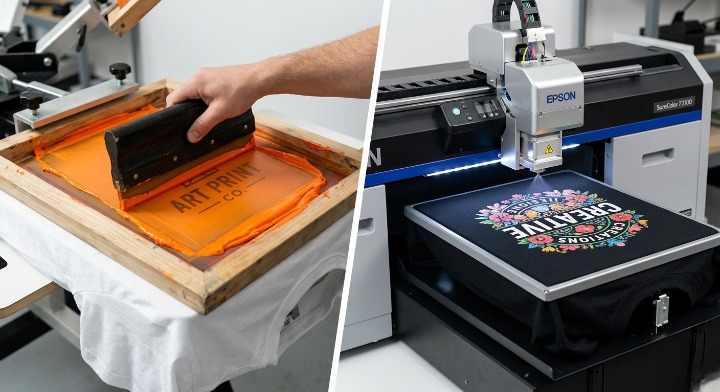
Screen printing is a traditional, analog method that has been perfected over centuries. It involves creating a stencil (or “screen”) for every single color used in a design. Thick plastisol inks are then pushed through the mesh screens directly onto the garment layer by layer.
What is DTG (Direct-to-Garment) Printing?
DTG printing is a modern, digital method. Think of it exactly like your office inkjet printer, but modified for t-shirts. The garment is loaded onto a platten, and a specialized print head sprays water-based textile inks directly into the fabric’s fibers. There are no screens, no stencils, and virtually no manual setup.
Head-to-Head Comparison for Bulk Orders
When you are ordering 50, 500, or 5,000 shirts, your priorities shift from “cool design” to cost, efficiency, and consistency. Here is how the two methods stack up across the metrics that matter most for bulk production.
1. Cost Efficiency & Volume Discounts
- Screen Printing: This is where screen printing absolutely shines. Because setting up the screens takes the most time and effort, the price per unit drops dramatically as your order volume increases. Once the screens are ready, running 500 shirts takes very little extra effort per shirt.
- DTG Printing: DTG costs the same to print the 1st shirt as it does the 500th shirt. Because the ink is expensive and the print machine moves at a fixed digital speed, print shops rarely offer steep volume discounts for DTG.
The Winner for Bulk: Screen Printing. It offers unmatched economies of scale.
2. Design Complexity and Color Count
- Screen Printing: Every color requires a separate screen, which adds to the setup cost. If your bulk order features a 12-color photo-realistic image, screen printing will be prohibitively expensive or technically impossible.
- DTG Printing: Because it’s digital, DTG can print millions of colors, gradients, and intricate photographic details in a single pass. The price remains the same whether your design is a simple white logo or a vivid psychedelic painting.
The Winner for Bulk: DTG, but only if your design is highly complex with complex gradients or photo prints.
3. Material Compatibility
- Screen Printing: Incredibly versatile. It works beautifully on cotton, polyester, blends, nylon, and even canvas bags.
- DTG Printing: DTG relies on water-based inks that need natural fibers to bind to. It works best on 100% cotton. Trying to print DTG on 100% polyester often results in dull, bleeding colors (dye migration).
The Winner for Bulk: Screen Printing. Bulk orders often utilize budget-friendly poly-blends or activewear fabrics, which screen printing handles flawlessly.
4. Turnaround Time
- Screen Printing: The setup takes time, but the actual printing process is incredibly fast (hundreds of shirts per hour). For massive bulk runs, screen printing is highly efficient.
- DTG Printing: Zero setup time means a shop can start printing your order instantly. However, the machine prints slowly. A bulk order of 1,000 shirts via DTG could take days of continuous machine running, whereas a screen printing press could crush it in hours.
The Winner for Bulk: Screen Printing (for large bulk), though DTG wins if you need a smaller bulk order (e.g., 20–30 shirts) turned around in 24 hours.
Summary Comparison Table
| Feature | Screen Printing | DTG Printing |
| Best Order Size | Large Bulk (50+ units) | Small batches (1–30 units) |
| Cost Per Unit | Decreases as volume increases | Stays flat regardless of volume |
| Color Limits | Limited (Usually capped at 6–8 colors) | Unlimited (Full CMYK color spectrum) |
| Feel on Shirt | Thicker, textured feel (Plastisol) | Soft, breathable feel (Water-based) |
| Best Fabric Match | Cotton, Polyester, Blends, Nylon | 100% Cotton preferred |
| Durability | Ultra-durable, resists fading | Highly durable, but may fade slightly over dozens of washes |
The Verdict: Which Is Better for Your Bulk Order?
Choose Screen Printing If:
- Your order is 50 pieces or more.
- Your design uses few colors (1 to 4 solid colors).
- You want the lowest possible price per shirt.
- You are printing on polyester, hoodies, or blended fabrics.
- You need vibrant, vibrant ink that stands out on dark garments.
Choose DTG Printing If:
- Your “bulk” order is relatively small (under 30-40 pieces).
- Your design is a photograph or contains complex gradients and shading.
- You are printing on 100% cotton and prefer a soft, “no-feel” texture to the print.
- You are utilizing a Print-on-Demand (POD) fulfillment model where items are printed as they are ordered.
For the vast majority of traditional bulk orders, Screen Printing remains the undisputed king. It protects your profit margins, delivers rugged durability, and rewards you for ordering in scale.
Related Posts