
Starting an embroidery business in 2026 can be a practical way to turn custom apparel, branded merchandise and personalised products into a profitable small business. From embroidered hats and shirts to jackets, patches and uniforms, businesses and customers continue to use embroidery for products that need a professional, durable finish.
The good news is that you do not necessarily need a large commercial embroidery setup from day one. A carefully selected embroidery machine, suitable supplies, quality designs and reliable digitizing can give a new business a strong starting point.
But how much does it cost to start an embroidery business in 2026? What equipment do you actually need? And should you digitize designs yourself or use a professional embroidery digitizing service?
This guide explains the key costs, equipment, digitizing basics and practical steps involved in starting an embroidery business in 2026.
Is an Embroidery Business Profitable in 2026?
Yes, an embroidery business can be profitable when you control equipment costs, price products correctly and focus on customers who value customised apparel.
Potential customers include:
- Small businesses ordering branded uniforms
- Sports teams and clubs
- Schools and organisations
- Restaurants and hospitality businesses
- Construction and trade companies
- Clothing brands
- Promotional product companies
- Event organisers
- Individuals ordering personalised gifts
- Businesses requiring embroidered patches and workwear
Profitability depends on more than the price you charge per embroidered item. You need to account for thread, garments, stabiliser, needles, digitizing, machine maintenance, labour, packaging, shipping, marketing and other operating costs.
A useful starting point is to calculate your total cost per embroidered item before setting your selling price.
How Much Does It Cost to Start an Embroidery Business in 2026?
The startup cost can vary considerably depending on whether you begin with a home-based single-head machine or invest in a multi-head commercial setup.
A basic embroidery business may require spending on:
| Startup Item | Typical Cost Range |
|---|---|
| Embroidery machine | $2,000–$15,000+ |
| Computer | $500–$1,500+ |
| Digitizing software | $0–$4,000+ |
| Thread | $100–$500+ |
| Needles | $20–$100 |
| Stabiliser/backing | $50–$300 |
| Hoops | $50–$500+ |
| Blank garments | $200–$1,000+ |
| Packaging | $50–$200 |
| Website and branding | $100–$1,000+ |
| Initial marketing | $100–$1,000+ |
These figures are planning estimates rather than fixed market prices. Machine specifications, software, brand, hoop size and business scale can significantly change the final investment.
For example, someone starting from home with a single-head machine can operate with a much smaller initial investment than a business purchasing a multi-head commercial machine.
Before purchasing equipment, compare machine capabilities, hoop sizes and production capacity. Our guide to Embroidery Machine Comparison 2026 can help you understand the differences between machine types.
What Equipment Do You Need to Start an Embroidery Business?
You do not need every piece of professional equipment immediately. Start with the equipment required for the products and order sizes you intend to sell.
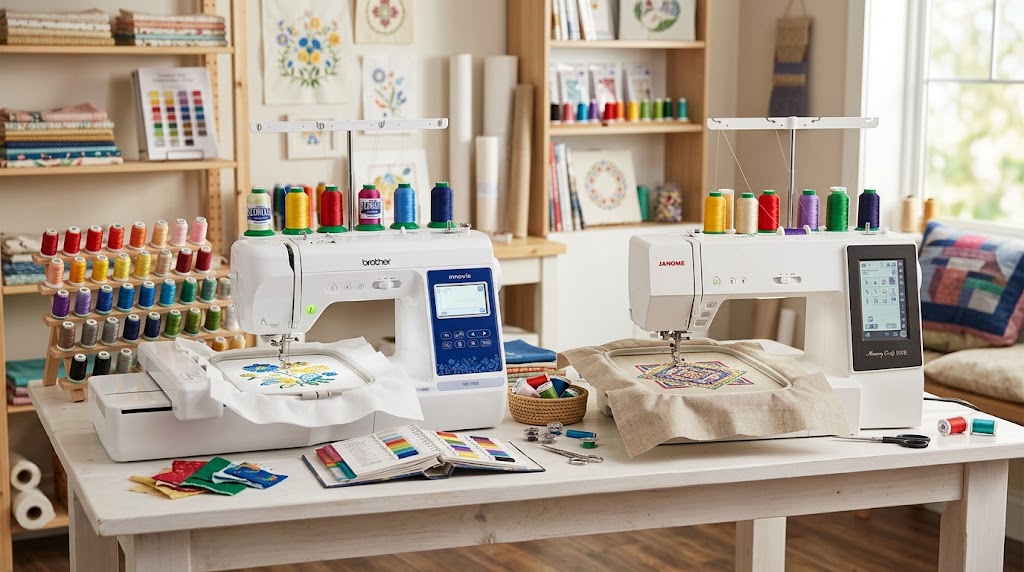
1. Embroidery Machine
The embroidery machine is the most important investment.
For a new business, you might consider:
- Single-head embroidery machines
- Multi-needle machines
- Commercial multi-head machines
- Machines designed specifically for caps and garments
A single-head machine can be suitable for testing a business model and handling smaller orders. Multi-head machines become more useful when production volume increases.
When comparing machines, look at:
- Number of needles
- Maximum embroidery area
- Hoop compatibility
- Maximum sewing speed
- Automatic thread trimming
- Cap embroidery capability
- Supported file formats
- Software compatibility
- Service and maintenance availability
You can also explore our guide to the best embroidery machines for beginners before choosing your first machine.
2. Computer
You will need a computer for managing designs, communicating with customers and transferring embroidery files to your machine.
Your computer does not necessarily need to be extremely powerful unless you plan to run demanding professional digitizing software.
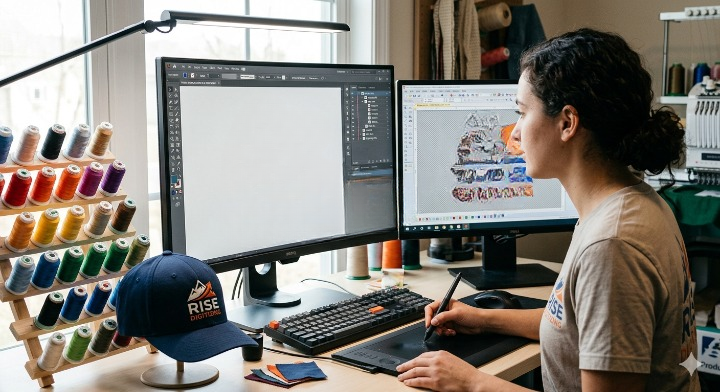
3. Embroidery Digitizing Software
Digitizing software converts artwork into instructions that an embroidery machine can stitch.
Depending on your requirements, software may allow you to:
- Create stitch objects
- Set stitch directions
- Select stitch types
- Adjust density
- Create underlay
- Add lettering
- Set thread colours
- Create machine-ready files
- Edit existing embroidery designs
If you are new to digitizing, read our Complete Guide to Embroidery Digitizing to understand how artwork becomes a stitch file.
4. Embroidery Hoops
Different products require different hoop sizes.
A larger hoop can accommodate larger designs, while smaller hoops are useful for compact logos and personalised items.
Before purchasing additional hoops, check which sizes are supported by your embroidery machine.
5. Embroidery Thread
Thread is another essential operating cost.
You may eventually need a broad range of colours, especially if you work with customer logos.
For commercial work, consistency is important. Keep track of thread colours and suppliers so that repeat orders can be reproduced accurately.
6. Stabiliser and Backing
Stabiliser helps support the fabric during embroidery and can reduce puckering, distortion and other stitching problems.
The appropriate stabiliser depends on factors such as:
- Fabric type
- Garment construction
- Design density
- Stitch count
- Embroidery location
- Whether the stabiliser remains permanently or is removed
7. Needles
Embroidery needles are consumable supplies and should be replaced regularly.
Different fabrics and thread types may require different needle sizes or types. Our guide on embroidery needles vs sewing needles explains the basic distinction.
Do You Need Embroidery Digitizing for Your Business?
Yes. If you want to embroider a customer’s logo or custom artwork, you generally need a suitable embroidery file rather than simply uploading a JPG or PNG directly to the machine.
Digitizing transforms artwork into stitch instructions.
For example, a customer might send you:
PNG logo → digitizing → embroidery file → machine → embroidered garment
The embroidery file contains information such as:
- Stitch types
- Stitch sequence
- Stitch direction
- Stitch density
- Thread colour changes
- Stitch placement
- Machine movements
This is why embroidery digitizing is different from simply converting an image file.
If you want to understand the distinction, see our guide on vector conversion vs embroidery digitizing.
Should You Digitize Designs Yourself or Outsource Them?
This is one of the biggest decisions for a new embroidery business.
Option 1: Digitize In-House
Learning to digitize gives you greater control over your designs.
Advantages include:
- More control over stitch settings
- Ability to make quick edits
- No outsourcing fee for every design
- Opportunity to develop advanced digitizing skills
- Better control over repeat orders
However, professional digitizing takes time to learn.
A beginner can create a design that looks acceptable on screen but produces poor embroidery because of incorrect density, underlay, stitch direction or sequencing.
Option 2: Use a Professional Digitizing Service
Outsourcing digitizing can be easier when you want to focus on sales and production.
A professional digitizer can prepare artwork according to the intended garment, fabric and embroidery size.
This can be particularly useful for:
- Business logos
- Detailed artwork
- Small lettering
- Cap designs
- Jacket designs
- Large back designs
- Complex embroidery
- Designs requiring multiple revisions
Before choosing a provider, consider quality, turnaround time, revision policies and pricing. Our guide to professional logo digitizing cost and why quality saves money explains why the cheapest digitizing option is not always the most cost-effective choice.
How Much Does Embroidery Digitizing Cost in 2026?
Embroidery digitizing prices vary according to design complexity, stitch count, size, number of colours and the required turnaround time.
A simple logo with limited colours may cost considerably less than a detailed design containing thousands of stitches and multiple elements.
Factors that can affect digitizing cost include:
- Design complexity
- Stitch count
- Design dimensions
- Number of colours
- Fabric type
- Required embroidery location
- Editing requirements
- Turnaround time
- File formats required
For more information, see How Much Does Embroidery Digitizing Cost in 2026? and our guide to embroidery digitizing cost per 1,000 stitches.
What Embroidery File Format Do You Need?
The correct file format depends on your embroidery machine.
Common embroidery formats include:
- DST
- PES
- VP3
- JEF
- EXP
- XXX
For example, Brother machines commonly use PES, while DST is widely used across commercial embroidery applications.
Do not assume that one embroidery file will work with every machine.
Before ordering digitizing, check your machine’s required format.
You can learn more in our Embroidery File Formats Supported guide and our comparison of DST vs PES vs VP3 embroidery file formats.
How Many Stitches Should an Embroidered Logo Have?
There is no universal stitch-count requirement for every logo.
A suitable stitch count depends on:
- Design size
- Fabric
- Detail level
- Stitch type
- Lettering
- Thread density
- Underlay
- Embroidery location
A small logo may require relatively few stitches, while a large detailed design may require many more.
More stitches do not automatically mean better quality. Excessive density can sometimes create unnecessary bulk, distortion or thread-related problems.
Read our guide on how many stitches a logo should have for more detail.
Choose the Right Products for Your Embroidery Business
One of the easiest ways to make your business more focused is to choose a few product categories instead of trying to embroider everything.
Popular options include:
Embroidered T-Shirts
T-shirts can work well for:
- Small business branding
- Events
- Clubs
- Merchandise
- Personalised apparel
Embroidered Polo Shirts
Polo shirts are popular for professional uniforms and company branding.
They can be suitable for:
- Restaurants
- Offices
- Trades
- Hospitality
- Retail teams
Embroidered Hats and Caps
Caps can be an attractive product because businesses, teams and clothing brands frequently use embroidered logos on headwear.
However, cap embroidery requires appropriate hoops, attachments and digitizing techniques.
See our guide on how to digitize a logo for a baseball cap before adding cap embroidery to your service list.
Embroidered Jackets
Jackets provide larger embroidery opportunities, including chest logos, sleeve designs and larger back artwork.
Our guide to digitizing for different garments explains why the same design may need different treatment depending on the garment.
Embroidered Patches
Patches can be sold separately or applied to garments.
You can offer:
- Logo patches
- Name patches
- Sports patches
- Club patches
- Uniform patches
- Custom fashion patches
If patches are part of your business plan, see our guide on how to make embroidered patches with an embroidery machine.
How to Price Embroidery Services
Pricing should cover your actual production costs while leaving room for profit.
A simple pricing calculation can include:
Garment cost + embroidery cost + digitizing cost + labour + supplies + overhead + profit = selling price
For example, suppose you have:
- Blank polo: $12
- Embroidery supplies: $2
- Labour: $5
- Digitizing allocation: $3
- Packaging/overhead: $3
Your approximate cost would be:
$25
You then need to add an appropriate profit margin rather than simply charging $26 or $27.
For repeat customers, you may also create separate pricing tiers for:
- 1–5 pieces
- 6–24 pieces
- 25–49 pieces
- 50+ pieces
Volume pricing can make larger orders more attractive while improving production efficiency.
How to Calculate Your Embroidery Cost Per Item
Your machine cost is only one part of production.
Track:
- Garment cost
- Thread consumption
- Stabiliser
- Needles
- Digitizing
- Machine running time
- Labour
- Electricity
- Packaging
- Shipping
- Marketing
- Equipment maintenance
Keeping accurate records helps you identify which products generate the strongest margins.
Create a Portfolio Before Looking for Large Orders
Customers want to see what your embroidery looks like before placing an order.
Create samples covering different products and design styles.
For example, create:
- A company logo on a polo
- A logo on a cap
- A detailed design on a jacket
- A small embroidered name
- A patch
- A simple monogram
- A large back design
Photograph your samples clearly and use them on your website, social media and business listings.
Your portfolio should demonstrate actual embroidery quality rather than relying entirely on digital mockups.
How to Find Your First Embroidery Customers
You can start with your existing network and local businesses.
Potential customer acquisition methods include:
Google Search
Create service pages targeting relevant searches such as:
- Custom embroidery near me
- Embroidery services
- Custom embroidered shirts
- Embroidered hats
- Custom embroidery patches
- Business logo embroidery
Our embroidery places near me guide shows how location-based embroidery searches can represent customer intent.
Local Businesses
Contact businesses that regularly need uniforms.
Potential prospects include:
- Restaurants
- Gyms
- Construction companies
- Security companies
- Cleaning companies
- Hotels
- Sports clubs
- Retail businesses
Offer a simple sample or quote rather than sending a generic sales message.
Social Media
Use Instagram, Facebook, TikTok and other visual platforms to show:
- Machine production
- Before-and-after artwork
- Close-up stitching
- New products
- Customer orders
- Custom patches
- Logo embroidery
Embroidery is highly visual, so good product photography can become an important marketing asset.
Build a Website for Your Embroidery Business
A professional website can help customers understand exactly what you offer.
Important pages can include:
- Home
- Custom embroidery
- Embroidered hats
- Embroidered shirts
- Embroidered patches
- Logo digitizing
- Pricing
- Portfolio
- About
- Contact
- FAQ
Each service page should clearly explain the product, process, turnaround time and ordering requirements.
For SEO, use natural phrases that match customer intent rather than repeatedly inserting the same keyword.
SEO Tips for an Embroidery Business in 2026
Local and organic search can help an embroidery business attract customers who are already looking for customised products.
Focus on:
Search Intent
Create content around different stages of the customer’s journey.
Informational:
- What is embroidery digitizing?
- How does machine embroidery work?
- What embroidery file do I need?
Commercial:
- Best embroidery digitizing service
- Embroidery machine comparison
- Custom embroidery services
Transactional:
- Custom embroidery
- Logo digitizing service
- Embroidered patches
- Embroidery near me
Local SEO
If you serve a particular city or region, optimise your website and business profile for relevant local searches.
Keep your business information consistent across important online platforms.
Helpful Content
Publish useful guides that answer genuine customer questions.
For example:
- How much does embroidery cost?
- How long does embroidery take?
- What file format does my machine need?
- How many stitches should a logo have?
- What is embroidery digitizing?
This can help establish topical relevance while giving potential customers useful information before they contact you.
Common Mistakes New Embroidery Businesses Should Avoid
Starting with the wrong strategy can make an embroidery business more expensive than necessary.
Buying Too Much Equipment Too Early
Do not purchase a large commercial machine before understanding your expected order volume.
Start with equipment appropriate for your current demand and upgrade when production justifies it.
Using Poor-Quality Digitizing
A poorly digitized design can produce:
- Thread breaks
- Puckering
- Poor registration
- Excessive density
- Uneven lettering
- Poor fabric coverage
Learn the fundamentals or use a professional digitizing service.
Underpricing Your Work
Many new businesses calculate only the garment and thread costs.
Remember to include labour, machine time, digitizing, overhead, packaging and maintenance.
Ignoring Test Stitch-Outs
Always test important or unfamiliar designs before producing a large customer order.
A design that looks good on a computer screen may behave differently when stitched onto the actual fabric.
Offering Too Many Products
Start with a focused product range.
Once you understand your production process and customer demand, expand into additional products.
A Simple 90-Day Plan to Start an Embroidery Business
Days 1–30: Research and Setup
During the first month:
- Choose your target market
- Decide which products to offer
- Research embroidery machines
- Set your initial budget
- Purchase essential supplies
- Choose digitizing software or a digitizing provider
- Register your business where required
- Create your branding
- Secure a domain and build your website
Days 31–60: Production and Portfolio
During the second month:
- Produce sample garments
- Test different fabrics
- Test logo sizes
- Build your portfolio
- Create service pages
- Establish pricing
- Photograph your work
- Set up social media profiles
- Create a Google Business Profile if applicable
Days 61–90: Marketing and Sales
During the third month:
- Contact local businesses
- Promote your services online
- Publish helpful SEO content
- Request customer reviews
- Test paid advertising if appropriate
- Track enquiries and conversions
- Identify your most profitable products
- Improve your pricing and production workflow
Is It Better to Start an Embroidery Business From Home?
For many beginners, a home-based model can reduce overhead while they test demand.
A home setup may allow you to avoid some costs associated with commercial premises, but you still need sufficient space, ventilation, electricity, storage and a suitable working environment.
Consider:
- Machine noise
- Garment storage
- Thread storage
- Work tables
- Computer space
- Customer order storage
- Shipping supplies
- Machine maintenance
As orders increase, you can evaluate whether moving to a dedicated commercial workspace makes financial sense.
Embroidery Business vs Screen Printing vs DTF
Embroidery is not the only custom apparel business model.
You may also consider:
- Screen printing
- Direct-to-film (DTF)
- Direct-to-garment (DTG)
- Heat transfer
Embroidery is particularly strong for professional logos, uniforms, hats, jackets and products where a textured stitched appearance is desirable.
For a broader comparison, read our DTF vs Screen Printing vs Embroidery 2026 guide.
How to Grow an Embroidery Business
Once your first orders become consistent, focus on improving efficiency rather than simply taking more orders.
Growth opportunities can include:
- Increasing average order value
- Offering volume discounts
- Adding embroidered patches
- Expanding into caps
- Adding jackets and workwear
- Offering logo digitizing
- Building business-to-business relationships
- Outsourcing specialist digitizing
- Investing in higher-capacity equipment
- Hiring production staff
- Building repeat-order accounts
The goal should be to create repeatable systems so that larger order volumes do not create unnecessary production problems.
Frequently Asked Questions
How much money do I need to start an embroidery business in 2026?
A small home-based embroidery business can potentially start with a few thousand dollars, while a larger commercial operation can require tens of thousands of dollars or more. The actual investment depends mainly on the machine, software, workspace, supplies and starting inventory you choose.
Is an embroidery business profitable?
An embroidery business can be profitable when products are priced correctly and operating costs are controlled. Profitability depends on factors such as order volume, equipment utilisation, labour, material costs, digitizing expenses and customer acquisition costs.
What embroidery machine should a beginner buy?
Beginners should compare machine type, hoop size, needle count, supported file formats, cap capability, ease of use, service availability and expected production volume before purchasing. A single-head or beginner-friendly multi-needle machine may be appropriate for a small startup, while higher-volume businesses may need multi-head equipment.
Do I need to learn embroidery digitizing?
You do not necessarily need to become an expert digitizer. You can learn digitizing yourself or outsource it to a professional service. However, understanding basic digitizing concepts helps you communicate better with digitizers and identify potential design problems.
What file format is best for embroidery?
There is no single best format for every machine. DST, PES, VP3, JEF and other formats are used by different embroidery systems. Always confirm the file format required by your specific machine.
How much does logo digitizing cost?
Logo digitizing costs vary according to design complexity, size, stitch count, colours, fabric and turnaround requirements. Simple logos generally require less work than detailed designs.
Can I start an embroidery business from home?
Yes, a home-based setup can be a practical way to test demand before investing in a larger commercial operation. You need enough space for the machine, supplies, garments, computer equipment and order storage.
How do I get my first embroidery customers?
Start by targeting local businesses, sports teams, organisations and individuals who regularly need customised apparel. Build a strong portfolio, create local service pages, use social media and ask satisfied customers for reviews and referrals.
Final Thoughts
Starting an embroidery business in 2026 does not require you to build a large commercial operation immediately. A focused product range, suitable embroidery machine, reliable supplies, accurate pricing and high-quality digitizing can provide a solid foundation.
The most important step is to understand your numbers before buying equipment. Calculate your startup budget, estimate your cost per item, determine how many orders you need each month and identify the products most likely to generate repeat business.
Quality should also remain a priority. Whether you digitize designs yourself or outsource the work, properly prepared embroidery files can make a major difference to the final product.
Start small, test your market, build a portfolio and reinvest in equipment and marketing as demand grows. With the right production process and a clear target market, an embroidery business can develop from a small home-based operation into a scalable custom apparel business.