
A plain jacket is just outerwear. A jacket with embroidered patches is a statement — it tells people who you are, what team or crew you belong to, or what story you’re wearing on your sleeve (literally). Whether you’re customizing a denim jacket, a leather biker jacket, or a varsity letterman, embroidered patches are one of the fastest, most affordable ways to turn something generic into something unmistakably yours.
This guide walks through everything you need to know before you order: patch types, placement, materials, pricing, and how to go from “idea” to “finished jacket.”
Why Embroidered Patches Are Having a Moment
Embroidered patches never really went away, but they’re back in a big way across streetwear, workwear, and vintage-inspired fashion. A few reasons they keep trending:
- They’re reversible customization. Unlike screen printing, patches can be added, moved, or removed without ruining the garment.
- They upgrade thrifted and old jackets. A worn denim or leather jacket gets a second life with the right patch placement.
- They’re brand-friendly. Businesses use them for uniforms, staff jackets, and merch drops because they look premium without the cost of full embroidery on every panel.
- They photograph well. Raised thread and dimensional stitching catch light in a way flat prints can’t.
Types of Jackets That Work Best With Embroidered Patches
Not every fabric behaves the same way under a needle. Here’s how the most popular jacket styles hold up:
Denim jackets — The easiest fabric to work with. Denim is thick and stable, so it holds stitching well and rarely puckers. This is the go-to choice for anyone starting with patches for the first time.
Leather and faux-leather jackets — Leather requires more careful digitizing and often a specific backing so the needle doesn’t tear the material. It’s worth working with a digitizer who has leather-specific experience.
Varsity/letterman jackets — Traditionally wool body with leather sleeves. Chenille or embroidered letters and patches are the classic look here, usually placed on the chest or sleeve.
Workwear and uniform jackets — Twill or canvas jackets used for uniforms typically feature a left-chest logo patch and sometimes a larger back patch for company branding.
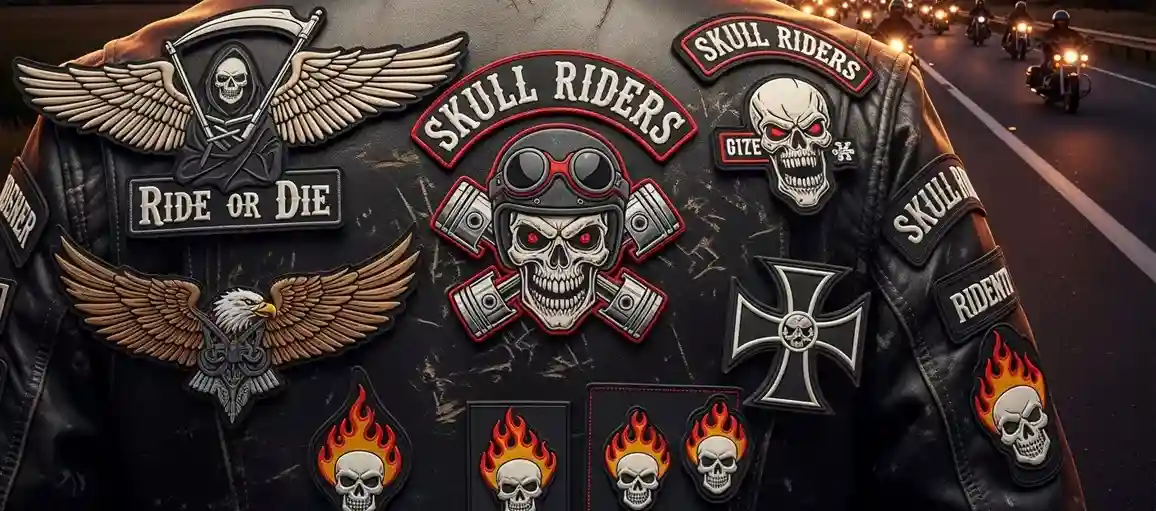
Biker jackets — Heavier fabric, larger surface area, and a long tradition of patch culture (club patches, event patches, “rockers” across the back).
Where to Place Your Patches
Placement changes the whole personality of the jacket. Common options:
- Left chest — The classic spot for a name, logo, or small emblem. Subtle and professional.
- Right chest — Often paired with a left-chest patch for a two-patch symmetrical look.
- Full back — The boldest option. Best for large artwork, club emblems, or statement graphics.
- Sleeve — Great for smaller patches, event badges, or a “collection” look with multiple patches down the arm.
- Scattered/collage style — Popular in streetwear — a mix of patch sizes across the jacket for a lived-in, collected-over-time aesthetic.
If you’re ordering a custom jacket with embroidered patches for a team or business, stick to one or two placements (usually left chest and back) for a consistent, professional result across every jacket.
Iron-On vs. Sew-On vs. Fully Stitched Patches
This is one of the most common questions customers ask before ordering:
- Iron-on patches have heat-activated adhesive backing. Fast to apply, but not ideal for leather or jackets that get heavy wash-and-wear.
- Sew-on patches are stitched onto the jacket after the patch is made — more durable, removable if stitched rather than glued, and the standard choice for biker and varsity jackets.
- Direct embroidery skips the “patch” step entirely — the design is stitched straight onto the jacket fabric. This gives the cleanest, most permanent look but works best on flat, accessible panels like the chest or back.
For most custom orders, sew-on embroidered patches offer the best balance of durability and flexibility — they survive washing and wear far better than iron-on backing alone.
What Affects the Cost of a Jacket with Embroidered Patches
A few factors determine pricing:
- Patch size — Bigger patches use more thread and more digitizing time.
- Stitch count / design complexity — Fine detail, small text, and gradients increase stitch density.
- Fabric type — Leather and denim take longer to digitize correctly than cotton or twill.
- Quantity — Bulk orders for teams or staff jackets typically bring the per-unit cost down.
If you already have a jacket and just need the patch and application, or you need a full logo digitized from scratch, get a free quote so you’re pricing the actual job, not a rough estimate.
From Design File to Finished Patch: How the Process Works
- Submit your artwork — logo, crest, hand-drawn design, or even a rough sketch.
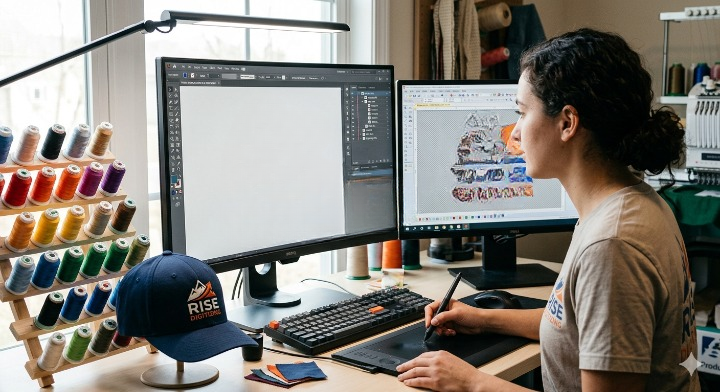
- Digitizing — your design is converted into a stitch-ready embroidery file, mapping out thread direction, density, and color changes.
- Approval — you review a proof before anything is stitched.
- Production — the patch is embroidered and finished with the appropriate backing (iron-on, sew-on, or Velcro).
- Delivery — the finished patch (or the fully patched jacket) ships to your door, or you receive the digitized file to hand off to a local embroiderer.
This is the exact workflow behind Rise Digitizing’s jacket with embroidered patches service, built for both individual orders and bulk business or team orders.
Tips for a Design That Digitizes Well
- Keep small text minimal. Anything under a certain point size can blur together once stitched.
- Limit color count. Every color change adds a thread stop; simpler palettes stitch cleaner and cost less.
- Use vector files when possible (AI, EPS, PDF). If you only have a JPEG or PNG, make sure it’s high resolution — a low-quality logo produces a low-quality patch.
- Think about contrast. Patches read best against jacket fabric that contrasts with the thread colors, not blends into them.
FAQs
How much does a jacket with embroidered patches cost? Pricing depends on patch size, stitch count, and jacket fabric — leather and denim take longer to digitize than cotton. Request a free quote for exact pricing on your design.
Can I add embroidered patches to a jacket I already own? Yes. Send in your design or logo, and it can either be stitched directly onto your jacket or delivered as a ready-to-stitch file for your local embroiderer.
What file formats work best for embroidery digitizing? Vector formats like AI, EPS, and PDF give the cleanest results. High-resolution JPEG or PNG files also work if a vector isn’t available.
How long does the whole process take? Most orders are completed within a few days from design approval to final delivery.
Do I need a local shop, or can this be done online? It’s entirely online. You get the same turnaround and quality wherever you’re located — the finished patches or jacket ship directly to you.
Ready to Customize Your Jacket?
Whether it’s a single custom patch or a full run of staff jackets, the process starts with your design. Get a free quote or explore custom embroidered patches and jacket logo digitizing to see examples of finished work.