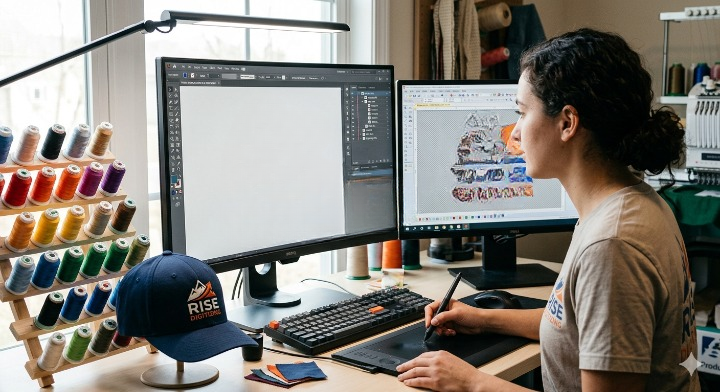
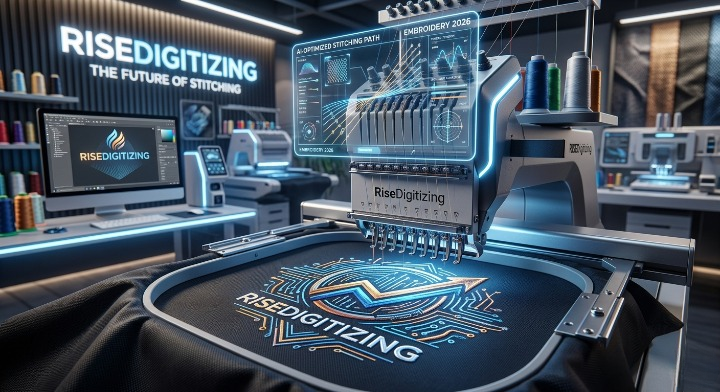

The year 2026 has officially ushered in the “Smart Stitch” era. For years, embroidery digitizing was a craft hidden behind complex software and years of manual apprenticeship. But today, the landscape has shifted. At RiseDigitizing, we’ve watched this evolution firsthand, integrating the latest artificial intelligence to redefine what’s possible for our clients.
From predictive stitch behavior to 3D virtual garment modeling, AI isn’t just making digitizing faster—it’s making it smarter. Here is how AI is fundamentally changing embroidery digitizing in 2026.
1. Predictive Stitch Physics and Fabric Adaptation
In the past, a digitizer had to guess how much a “left chest” logo would pull on a performance polo versus a heavy hoodie. In 2026, AI has eliminated the guesswork through Predictive Stitch Physics.
- Fabric-Aware Algorithms: Modern AI tools now analyze the specific weave and GSM (grams per square meter) of a fabric before a single stitch is placed.
- Automatic Compensation: The software automatically calculates “push and pull” compensation based on the stretch profile of the material, ensuring that circles stay circular and columns stay aligned.
- Reduced Thread Breaks: By predicting high-tension areas, AI adjusts the sewing path to prevent the dreaded needle-break or thread-shredding mid-run.
2. The Rise of “Redwork” and Vector Automation
While “Auto-Digitizing” used to be a dirty word in the professional industry due to poor quality, 2026-grade AI has changed the narrative. Tools like Wilcom EmbroideryStudio 2026 have introduced advanced Redwork Automation and Multi-Blend Tools.
- Instant Vector-to-Stitch: AI can now take a complex vector file and instantly suggest the most efficient pathing (sequencing) to minimize trims and jump stitches.
- Intelligent Snapping: Smart snapping controls allow digitizers to “lock” stitches to organic shapes with 99% accuracy, significantly cutting down the time spent on manual node editing.
3. 3D Virtual Prototyping (The Style3D Revolution)
One of the biggest shifts in 2026 is the integration of 3D visualization like Style3D. Before a machine even starts, RiseDigitizing can now provide a hyper-realistic digital twin of the finished product.
- Virtual “Puff” Testing: You can see exactly how a 3D puff foam design will look from every angle.
- Texture Simulation: AI simulates the way light hits different thread types (metallic, polyester, or matte), allowing brands to approve designs without the cost and waste of physical sampling.
4. Generative Design and Lettering
AI is now a co-creator. For custom apparel brands, generative AI can suggest font pairings and layout adjustments based on the “vibe” of the artwork.
- Contextual Lettering: If a word is too small to be legible, the AI prompts the digitizer to increase the column width or switch to a “micro-font” setting automatically.
- Style Transfer: Want a logo to look like a hand-cranked vintage chain stitch? AI filters can now apply these complex textures to modern logos with a single click.
Why Manual Expertise Still Wins at RiseDigitizing
Despite these leaps in technology, AI is a tool, not a replacement. At RiseDigitizing, we believe the “human touch” is what separates a good design from a masterpiece.
AI often misses the artistic intent—the way a satin stitch should flow to catch the light or the specific density needed for a vintage “distressed” look. We use AI to handle the heavy lifting of pathing and physics, but our master digitizers still hand-tune every file to ensure it meets our rigorous quality standards.
FAQ: Embroidery Digitizing in 2026
Q: Is AI-digitized embroidery lower quality than manual digitizing?
A: In 2026, it depends on the “post-edit.” Raw AI output has improved significantly but still requires a human expert to check the sewing order and density. At RiseDigitizing, we use a hybrid approach to ensure maximum efficiency without sacrificing quality.
Q: Can AI digitize a photo into stitches perfectly?
A: AI “Photo-Stitch” technology is better than ever, especially for tonal gradients. However, for a clean, professional look that doesn’t feel like a heavy “carpet” of thread, manual refinement is still necessary to reduce stitch count.
Q: How does AI help in reducing production costs?
A: By optimizing the “pathing” (the route the needle takes), AI reduces the number of “trims” and “jumps.” Fewer trims mean the machine runs faster, reducing the cost per garment and increasing your profit margins.
Q: Will AI replace human digitizers by 2030?
A: Unlikely. Embroidery is a physical medium involving thread tension and fabric variables. While AI will handle the technical “math,” the creative decisions and troubleshooting for unique fabrics will always require a human expert.
Ready to bring your brand into the future?
At RiseDigitizing, we combine 2026 cutting-edge AI technology with decades of manual expertise to provide the world’s best embroidery digitizing services.