
If you are new to embroidery, you may wonder whether you can use a regular sewing needle for embroidery or whether you need a special embroidery needle. Although sewing and embroidery needles may look very similar, they are designed with different purposes in mind.
So, are embroidery needles different from sewing needles?
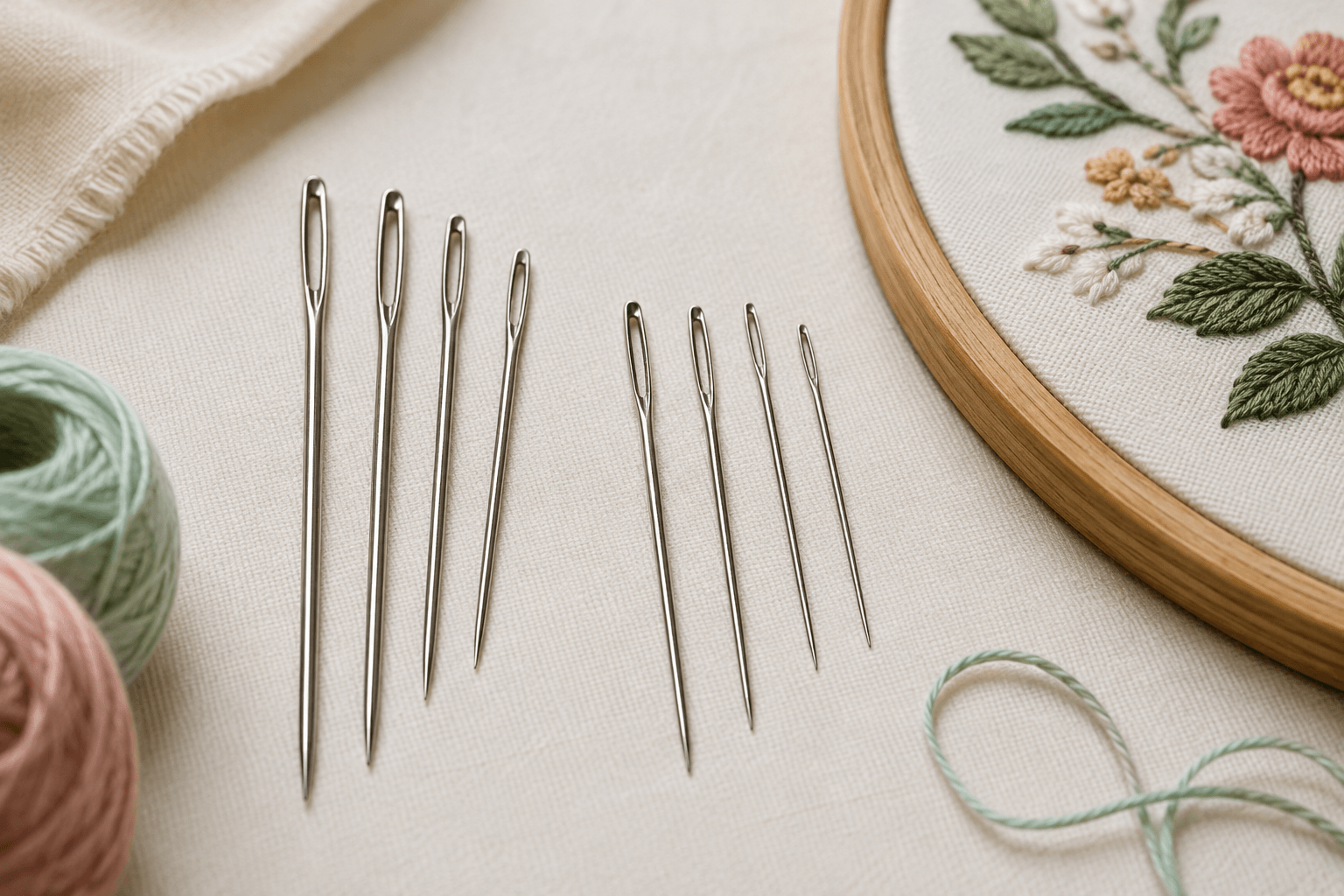
Yes. Embroidery needles are specifically designed to work with embroidery threads, floss, and decorative stitching. They typically have a larger and longer eye than many standard sewing needles, making it easier to thread thicker or multiple strands of embroidery thread.
However, this does not mean that regular sewing needles can never be used for embroidery. The best needle depends on the type of embroidery, thread, fabric, and stitching technique you are using.
In this guide, we explain the differences between embroidery needles and sewing needles, when to use each type, how needle sizes work, and how to choose the right needle for your project.
What Is an Embroidery Needle?
An embroidery needle is a hand-sewing needle designed specifically for embroidery work.
One of its most noticeable features is its larger eye, which makes it easier to thread embroidery floss, stranded cotton, metallic thread, and other thicker decorative threads.
Embroidery needles are available in different sizes. The correct size depends on the fabric, thread thickness, and embroidery technique.
A smaller needle may be appropriate for fine fabrics and delicate designs, while a larger needle can accommodate thicker threads.
If you are learning embroidery from the beginning, understanding the tools is an important first step. You can also explore these simple embroidery techniques to understand how different stitches are created.
What Is a Sewing Needle?
A sewing needle is a general-purpose needle used for sewing fabric.
Sewing needles are available in many different types, including needles designed for:
- General hand sewing
- Fine fabrics
- Heavy fabrics
- Quilting
- Leather
- Upholstery
- Decorative sewing
- Specialized sewing techniques
A standard sewing needle generally has a smaller eye than an embroidery needle, particularly when it is designed for lightweight sewing thread.
The needle you choose should match both the fabric and the thread.
Are Embroidery Needles and Sewing Needles the Same?
No, they are not exactly the same.
Both needles perform the basic function of passing thread through fabric, but their designs can differ depending on their intended use.
The biggest differences usually involve:
- Eye size
- Needle length
- Needle thickness
- Point design
- Intended thread type
- Intended fabric
- Embroidery or sewing technique
An embroidery needle is optimized for embroidery threads and decorative stitching, while a standard sewing needle is generally designed for conventional sewing thread and seams.
Embroidery Needle vs. Sewing Needle
Here is a simple comparison:
| Feature | Embroidery Needle | Sewing Needle |
|---|---|---|
| Main purpose | Embroidery and decorative stitching | General sewing |
| Eye | Usually larger | Often smaller |
| Thread compatibility | Embroidery floss and decorative threads | Sewing thread |
| Common use | Embroidery designs and decorative stitches | Seams, repairs, alterations |
| Sizes | Available in multiple sizes | Available in multiple sizes |
| Fabric compatibility | Depends on needle size | Depends on needle type and size |
The distinction is not absolute because there are many needle types, and some sewing needles can also work well for embroidery.
Why Do Embroidery Needles Have Larger Eyes?
The larger eye is one of the most useful characteristics of an embroidery needle.
Embroidery often uses thicker thread or multiple strands of floss. Trying to push several strands through the small eye of a regular sewing needle can be frustrating.
A larger eye makes it easier to:
- Thread multiple strands
- Use thicker embroidery thread
- Reduce thread friction
- Change threads more easily
- Work with decorative fibers
This is especially helpful when working on detailed hand embroidery.
Can You Use a Sewing Needle for Embroidery?
Yes, in some situations.
A regular sewing needle can be used for simple embroidery if it is suitable for the fabric and thread.
For example, if you are using a relatively thin thread and lightweight fabric, a general-purpose needle may work.
However, using the wrong needle can make embroidery more difficult.
You may experience:
- Difficulty threading the needle
- Thread fraying
- Broken thread
- Fabric damage
- Poor stitch formation
- Difficulty pulling the thread through the fabric
For frequent embroidery projects, using a suitable embroidery needle can make the process more comfortable.
Can You Use an Embroidery Needle for Sewing?
You can use an embroidery needle for some types of hand sewing, but it may not always be the best choice.
If you are repairing a garment with standard sewing thread, a conventional sewing needle may be more appropriate.
Embroidery needles are designed around the requirements of embroidery thread and decorative work. Their larger eye can also be less suitable for certain fine sewing tasks.
The right needle depends on the job.
What Size Embroidery Needle Should You Use?
Needle size is one of the most important factors when selecting an embroidery needle.
Generally, needle sizes work differently from what beginners might expect: the larger the numerical size, the finer or smaller the needle can be, depending on the needle numbering system.
The exact sizing convention can vary by needle type and manufacturer, so it is useful to check the packaging.
Instead of selecting a needle based only on the number, consider:
- Thread thickness
- Fabric thickness
- Stitch density
- Design detail
- Number of thread strands
A good needle should pass through the fabric smoothly without creating unnecessarily large holes.
How Does Fabric Affect Needle Choice?
The fabric you are embroidering plays an important role in choosing the needle.
Lightweight Fabric
Fine fabrics generally require a finer needle.
A thick needle can create visible holes or distort delicate material.
Medium-Weight Cotton
Medium-weight cotton is relatively forgiving and can work with a variety of embroidery needle sizes.
Denim
Denim is much heavier than standard cotton fabric. A stronger needle may be required to penetrate the material effectively.
Canvas
Heavy canvas may require a larger or stronger needle suitable for dense fabric.
Stretch Fabric
Stretch fabrics require extra care because the wrong needle can cause distortion or unwanted holes.
How Does Thread Affect Needle Choice?
Thread and needle selection should work together.
If you are using multiple strands of embroidery floss, choose a needle with an eye large enough to accommodate the thread comfortably.
If the eye is too small, the thread can become damaged as it repeatedly passes through the needle.
If the needle is too large, it may leave unnecessarily large holes in the fabric.
The goal is to find a practical balance between the thread and fabric.
Embroidery Floss vs. Sewing Thread
Another reason embroidery needles differ from standard sewing needles is the type of thread commonly used.
Embroidery floss is often thicker and may be divided into several strands. Depending on the design, you may use one, two, three, or more strands.
Sewing thread is generally finer and designed for seams and garment construction.
Because embroidery often involves decorative thread arrangements, a larger needle eye can be beneficial.
If you are interested in embroidery thread requirements, see this guide on how much embroidery thread you need.
What Are Embroidery Needles Used For?
Embroidery needles are commonly used for hand embroidery techniques such as:
- Satin stitch
- Backstitch
- Running stitch
- French knots
- Chain stitch
- Cross stitch
- Decorative stitching
- Surface embroidery
Different embroidery styles may benefit from different needle sizes.
For example, detailed embroidery on fine fabric may require a finer needle, while thick decorative thread may require a larger eye.
If you want to understand how embroidery compares with other needle-based crafts, see the difference between cross stitch and embroidery.
Are Embroidery Needles Sharper Than Sewing Needles?
Not necessarily.
Sharpness depends on the specific needle type.
Some embroidery needles have sharp points because they need to penetrate woven fabric cleanly. However, different embroidery techniques and fabrics may require different points.
The important factor is selecting a needle appropriate for the material.
Using an unsuitable needle can cause:
- Fabric pulls
- Enlarged holes
- Thread damage
- Uneven stitches
What Happens If You Use the Wrong Needle?
Using the wrong needle does not always ruin an embroidery project, but it can create problems.
The Thread May Fray
If the eye is too small or rough, repeated movement can damage the thread.
The Needle May Be Difficult to Pull
A needle that is too large or unsuitable for the fabric may require excessive force.
The Fabric May Develop Large Holes
A needle that is too thick can create visible holes.
Stitches May Look Uneven
The relationship between thread, needle, and fabric affects stitch appearance.
Threading May Become Difficult
A small needle eye can be frustrating when working with multiple strands.
Do Embroidery Machines Use Different Needles?
Yes.
Machine embroidery uses specialized embroidery-machine needles designed to work with the speed and movement of an embroidery machine.
Machine embroidery needles are different from ordinary hand embroidery needles.
They need to handle:
- High-speed needle movement
- Repeated penetration
- Machine embroidery thread
- Different fabric types
- Dense embroidery designs
The correct machine needle also depends on the fabric and thread being used.
If you are interested in machine embroidery, explore this guide to embroidery machines.
Hand Embroidery Needles vs. Machine Embroidery Needles
These two should not be confused.
Hand embroidery needles are designed to be held and controlled manually.
Machine embroidery needles are designed to fit into a specific embroidery machine and operate at high speeds.
Although both are used for embroidery, their construction and application are different.
Using a hand embroidery needle in an embroidery machine is not a substitute for using the correct machine needle.
What Needle Is Best for Beginners?
Beginners should choose a needle that is easy to thread and appropriate for the fabric and embroidery thread.
An embroidery needle with a reasonably sized eye can make learning easier because threading multiple strands becomes less frustrating.
A beginner’s basic embroidery kit might include:
- Embroidery needles
- Embroidery floss
- Embroidery hoop
- Fabric
- Small embroidery scissors
- Needle threader
- Embroidery patterns
As your skills improve, you can experiment with different needle sizes and thread combinations.
You can also explore the best embroidery machines for beginners if you want to move from hand embroidery into machine embroidery.
How Do You Know When to Change Your Embroidery Needle?
Embroidery needles can become dull or damaged with repeated use.
Consider replacing your needle if:
- It becomes difficult to push through fabric
- The needle feels rough
- The point is damaged
- The thread starts fraying unexpectedly
- The needle bends
- Your stitches become inconsistent
A damaged needle can affect both the thread and fabric.
Can One Needle Work for Every Embroidery Project?
Not necessarily.
There is no single perfect embroidery needle for every project.
Your needle choice should consider:
- Fabric type
- Fabric thickness
- Thread type
- Number of thread strands
- Stitch density
- Design complexity
- Embroidery technique
A needle that works perfectly for cotton may not be ideal for denim or delicate fabric.
Embroidery Needles for Dense Designs
Dense embroidery designs contain a large number of stitches in a relatively small area.
This can place additional demands on the needle, thread, and fabric.
When working with dense designs, the needle should be appropriate for both the material and thread.
Machine embroidery designs also depend heavily on proper digitizing.
Poorly digitized artwork can create excessive stitch density, unnecessary thread changes, or other stitching problems.
If you want to understand how embroidery designs are prepared, read the complete guide to embroidery digitizing.
Does Embroidery Needle Size Affect Stitch Quality?
Yes.
Needle size can affect the appearance and performance of embroidery.
A needle that is too large can create unnecessarily large holes.
A needle that is too small may struggle to accommodate the thread or pass smoothly through the fabric.
Choosing the appropriate needle helps create cleaner, more consistent stitches.
Embroidery Needle Selection: A Simple Guide
When choosing an embroidery needle, use this simple process.
Step 1: Identify the Fabric
Determine whether you are working with cotton, denim, canvas, polyester, knit fabric, or another material.
Step 2: Check Your Thread
Look at the thickness and type of embroidery thread.
Step 3: Decide How Many Strands You Will Use
Multiple strands require a needle eye large enough to accommodate them.
Step 4: Consider the Design
Fine, detailed designs may require a different needle from bold, dense designs.
Step 5: Test Before Starting
Make a few stitches on a scrap piece of the same or similar fabric.
Check whether the needle passes smoothly and whether the stitches look clean.
Common Mistakes When Choosing an Embroidery Needle
Choosing Based Only on Needle Size
The number alone does not tell you everything. Fabric and thread also matter.
Using a Needle With an Eye That Is Too Small
This can make threading difficult and may damage the thread.
Choosing a Needle That Is Too Thick
An oversized needle can leave larger holes in the fabric.
Ignoring the Fabric
A needle suitable for cotton may not be ideal for heavy or delicate material.
Continuing With a Damaged Needle
Bent or damaged needles should be replaced rather than reused.
Frequently Asked Questions
Are embroidery needles different from sewing needles?
Yes. Embroidery needles are designed specifically for embroidery and commonly feature an eye that is more suitable for embroidery floss and decorative threads. Sewing needles are available in many types and are generally designed for sewing tasks.
Can I use a regular sewing needle for embroidery?
Yes, a suitable sewing needle can sometimes be used for simple embroidery, particularly with thin thread. However, an embroidery needle may be more convenient when using embroidery floss or multiple strands.
Are embroidery needles sharper than regular needles?
Not necessarily. Sharpness depends on the specific needle type and its intended fabric. The important consideration is whether the needle is appropriate for your embroidery project.
What is the main difference between an embroidery needle and a sewing needle?
One of the main differences is the eye. Embroidery needles generally have an eye designed to accommodate embroidery floss and thicker or multiple strands of thread.
Can embroidery needles be used for sewing?
They can be used for some hand-sewing tasks, but a standard sewing needle may be better for conventional sewing and garment repairs.
What size needle is best for embroidery?
The correct size depends on your fabric, thread, number of strands, and embroidery technique. There is no single size that works for every embroidery project.
Do machine embroidery needles differ from hand embroidery needles?
Yes. Machine embroidery needles are specifically designed to fit embroidery machines and withstand rapid, repeated needle movement.
How often should I replace an embroidery needle?
Replace the needle when it becomes dull, bent, damaged, rough, or begins causing thread or fabric problems.
Final Thoughts
So, are embroidery needles different from sewing needles? Yes, although they share the same basic purpose of passing thread through fabric, they are designed with different applications in mind.
Embroidery needles generally have an eye that makes them more convenient for embroidery floss, multiple strands, and decorative threads. Standard sewing needles are designed for a broader range of sewing tasks and come in many different types.
The best needle ultimately depends on your fabric, thread, stitch type, and embroidery technique.
For simple projects, a suitable sewing needle may work. For dedicated embroidery work, choosing the correct embroidery needle can make threading easier, reduce thread damage, and help produce cleaner stitches.
If you are working with machine embroidery, remember that machine embroidery needles are a separate category and should be selected according to the machine, fabric, thread, and design.
Good embroidery is not only about choosing the right thread and needle. Proper design preparation also matters. If you are creating machine embroidery, learning about embroidery digitizing services can help you understand how artwork is converted into stitch-based embroidery designs.